Warning: Constant FS_CHMOD_DIR already defined in /home/umwdtltc/public_html/wp-config.php on line 101

Warning: Constant FS_CHMOD_FILE already defined in /home/umwdtltc/public_html/wp-config.php on line 101

Warning: Cannot modify header information - headers already sent by (output started at /home/umwdtltc/public_html/wp-config.php:101) in /home/umwdtltc/public_html/wp-includes/feed-rss2.php on line 8
Digital Liberal Arts – UMW Division of Teaching and Learning Technologies https://umwdtlt.com Wed, 23 May 2018 20:01:32 +0000 en hourly 1 https://wordpress.org/?v=7.1.5 https://i0.wp.com/umwdtlt.com/wp-content/uploads/2017/11/cropped-dtlt-black1.png?fit=32%2C32&ssl=1 Digital Liberal Arts – UMW Division of Teaching and Learning Technologies https://umwdtlt.com 32 32 103540615 New Resource for Faculty: Student Beta-Testers https://umwdtlt.com/new-resource-for-faculty-student-beta-testers/ Wed, 23 May 2018 16:00:42 +0000 http://umwdtlt.com/?p=57791 Starting in the Fall 2018 semester, DTLT, the DKC, and the HCC are offering a new resource for faculty: Student Beta-Testers. These students have gone through training in metacognition, assignment design, and feedback techniques, as well as online learning, and are ready to “beta test” assignments or online courses. We ran a successful pilot during the 2017-18 academic year and are excited to bring it to the larger UMW community. If you are interested in working with Beta-Tester or have any other questions, please email us at dtlt@umw.edu.

My undergraduate degree is in English Studies, specializing in Professional Writing. It was a small program at the large university I attended, if you can even imagine the size of a highly-specialized English degree being offered at a French university. Because of the size of the program, we were a really tight community. We found ourselves in classes with upperclassmen as freshmen. Because of the unique work-study set up of the program, what classes you had to take and when was very regimental. It was also the mid-1990s when what it meant to be a professional writing (translator, copywriter, technical writer, journalist, etc) was changing rapidly. Students who were fresh off their work terms were noting how the classes hadn’t prepared them for the realities of their jobs. There was general dissatisfaction about the education was providing the students and how.

I loved the program, I loved the people, I loved the professors, and I loved to write. I also loved the school, where I was. I wanted to be successful, and I wanted my friends to be successful, too. So, I organized a meeting between the students in the program and the faculty to discuss our concerns with the program, as well as the limitations faculty were facing in a small program such as ours. That conversation initiated an overhaul of the curriculum, streamlining or revising certain required courses, jettisoning old courses that were no longer relevant, and adding new courses to curriculum.

Obviously, I believe that undergraduates can have important and profound ideas about their own educations (debates about student evals aside). One of the first things I wanted to do when I started at DTLT was to integrate more undergraduate students into our work with faculty. But how? How do we create an environment where students, DTLT staff, and faculty can work together productively to improve the teaching and learning here at UMW.

There were some big, well-funded examples at Bryn Mawr and Haverford Colleges, where students are embedded with faculty over the course of an academic year, working with them on course design, assignment design, and even observing their teaching. Other institutions, like Bucknell or Harvard, had students working with student and faculty, a kind of hybrid DKC/DTLT roll for them. Given our limited resources, I know I couldn’t do something at such a large scale here, but I knew I could do something.

I was always struck by the conversations I would overhear in the DKC when students come in for peer-tutoring help with their assignments. The students and tutors would often get caught in “stuck points” in trying to execute the assignment, and were left scratching their heads. One day, a colleague of mine on social media was lamenting that she couldn’t ask her students where they were getting stuck in the online course she was running. And that’s when it hit me: What if we could have students go through the process ahead of time and give feedback on these stuck points?

The ida for the Beta-Testers was born. I developed a 5-week asynchronous training for the Beta-Testers. There are “modules” on metacognition, assignment design, feedback, and online learning, as well as a practicum, where they would give me feedback on the Domain of One’s Own modules. I had to be mindful that each module needed to be completed in a week while the student was working, so in less than 10 hours. Much less, given the responsibilities they did have during their jobs.

Now, all I needed were students who were interested and willing. Oh, and not so insignificantly, money to compensate them for their work. Thankfully, my colleagues Martha Burtis (Director of the DKC) and Cartland Berge (Building Manager of the HCC and supervisor for the desk aides in the building) came through with an idea: why not train willing DKC tutors and desk aides and make it a part of their job? It was perfect.

Six students volunteered to be the first Beta-Testers. While most of the training was asynchronous, done while they were working at the InfoDesk or DKC, we did end up meeting twice during the process. At the first meeting, when I asked them why they volunteered to do this, they all answered that one reason was because they wanted to give back to the institution, to improve it for future students. This is when I knew the program was going to be a success.

We used Slack to have discussions about the readings and Google Docs to collaboratively develop a kind of assessment guide for giving feedback to faculty. The timing of the training was a little strange, straddling the end of the fall semester and picking up at the beginning of the spring. They gave me both valuable feedback on the module and on the training itself.

We worked with a few faculty, and got such positive feedback, we decided that we would make the training available to all DKC tutors and HCC desk aides. Four of our original Beta-Testers are back in the fall and immediately able to work with faculty. We are also open to ideas how else the Beta-Testers can work with faculty, the DKC, and DTLT.

Again, if you are interested in working with Beta-Tester, please email us at dtlt@umw.edu.

Photo by chuttersnap on Unsplash

]]>
57791
This Month at DTLT – April 2018 https://umwdtlt.com/this-month-at-dtlt-april-2018/ Thu, 03 May 2018 14:54:53 +0000 http://umwdtlt.com/?p=57710 It’s finals week, and everyone is busy closing out the semester. We’re sad to be saying goodbye in less than two weeks to our two aides, Bethany and Stefanie, who are graduating seniors. They have done tremendous work with us over the past academic year, and we are sad to see them go, but thrilled to see where their skills, talent, and enthusiasm take them moving forward. We’ll always have our sweatshirts to keep us warm with their memory.

The online teaching cohort completed their first semester together, reading works by Paulo Freire, bell hooks, selected works from Hybrid Pedagogy, and exploring the intersections between critical pedagogy and online course design. In the next phase of their work together, the cohort will participate in two separate digital learning experiences—a self-guided Canvas course about using Canvas for course design, and a facilitated, partly synchronous course about critical instructional design. Instructors who participated this term are all enthusiastic about continuing their work together. Kristin Marsh, Tracy Citeroni, Suzie Kim, Jackie Gallagher, Melina Patterson, Melanie Szulczewski, Virginia Mackintosh, and Jason Robinson will finish off the next phase of this cohort by writing and submitting an online course proposal to the Distance and Blended Learning Committee. This group was lead by Sean with assistance from Nigel.

We also concluded the year long Digital Knowledge faculty development initiative, which gathered a brilliant cohort of faculty and staff, including Marjorie Och, Julia DeLancey, Chelsea Hampton, Parrish Waters, Shannon Hauser, and Angie White. This initiative was co-lead by Jesse with Martha and Jess.

The Advisory Group on Digital Fluency met to begin the process of identifying courses that could be considered “Digitally Intensive” and begin to understand and assess these learning outcomes. The group consists of a number of faculty and staff advisors from across campus: Bellah Fontem, Janine Davis, Zach Whalen, Sean Morris, Angie White, and Parrish Waters, lead by Lee.

Jess attended a grant workshop at UVa this month to assist us in seeking external funding for the work we do. We’re very excited to have this new set of expertise in our office! She has also been doing work with Safe Zone and volunteered at the Day of Silence BBQ.

Nigel has been developing a number of projects, including an asynchronous online “Welcome to Canvas” course for UMW faculty, to be launched this summer. Alongside assisting faculty the usual end-of-semester Canvas issues, he has also started redesigning his own course in Canvas with a learning mastery approach to grading, with the hopes of being able to provide it as a model to faculty.

Lee wrote a number of blog posts about digital fluency, released the latest Closing Tabs podcast with Mike Caulfield, and oversaw the publication of two guest posts from colleagues from UMW Libraries: Sharing our Community: UMW Assignment Bank by Peter Catlin and Introducing Digital Collection: An Access and Preservation Platform by Angie White. We value our collaborations with the UMW Libraries, as our work intersects and builds off of our shared goals and vision for digital fluency here at UMW.

Jesse published Textbooks, OER, and the Need for Open Pedagogy and was quoted in a piece about textbooks in the Washington Post. This was on top of his responsibilities as our fearless leader.

Sean published Instructional Designers are Teachers, and has been hard at work planning this year’s Digital Pedagogy Lab. As the semester winds down, we’re all starting to increasingly pitch in to ensure the event’s success. Jesse, Martha, Jess, Nigel, and Lora Taub-Pervizpour are working on a digital storymaking project for this year’s event. Jess has designed the t-shirts, while Bethany has been working on designing a map for participants. Lee is planning her one-day course on digital fluency, as well as coordinating with UMW DPL Alumni to better understand how the event can better meet their faculty development needs.

As of May 1, three of the DPL 2018 courses have filled and two others are about to fill. There are participants coming from around the world to participate in this event. This is an opportunity for UMW faculty and staff to engage in conversations and collaborations with a wide variety of respected educators. Even if you can’t make the entire event, we have two open keynotes: Anya Kamenetz on Monday, July 30th, and Jade E. Davis on Wednesday, August 1st, both from 4:30-6:00pm in the Digital Auditorium.  

As the semester winds down, we at DTLT wish you a restful and productive (and fun!) summer. We’re around all summer if you want to get ahead of your planning for the fall. We have a number of initiatives for next year that we’ll working on, ready to launch in August. Have a great summer!

Photo by Ankush Minda on Unsplash

]]>
57710
Introducing Digital Collections: An Access and Preservation Platform https://umwdtlt.com/introducing-digital-collections-an-access-and-preservation-platform/ Mon, 30 Apr 2018 10:00:13 +0000 http://umwdtlt.com/?p=57694 This is cross-posted from The Spinning Wheel blog, maintained by UMW Libraries Special Collections and University Archives.

In celebration of Preservation Week, UMW Libraries is excited to announce the release of a new digital preservation and access platform, Special Collections and University Archives: Digital Collections, powered by Preservica. Simpson Library has been providing access to its unique digitized collections for ten years, and this new platform takes our digital preservation initiatives to a higher level, as well as provides the user community with more materials for research. Many of our readers may be familiar with Archives@UMW, our previous platform, and we hope that you will find just as much use and enjoyment from our new system as we move forward with our digital preservation technology and goals.

A screen capture of the home page of the Digital Collections system. It shows an introductory paragraph and five collections.
The home page of the new Digital Collections system.

As more and more formats are created and used by our University community, library staff must develop strategies to select, acquire, preserve, and provide access to these unique resources. While we will always archive traditional, analog formats, many of our campus community members submit papers as PDFs rather than printed pages, and create class projects on blogs and YouTube rather than poster board. In addition to viewing our fantastic physical materials, we know that future researchers will also want to take a look at those PDFs, videos, and websites. A large part of our mission at Special Collections and University Archives is to collect the institution’s history, and much of that today is digital.

While storing multiple copies of digital resources is always a good start, we also want to make sure we are pursuing active digital preservation. That is, we need to constantly be able to assess the usability of our digital files, making sure they are formatted for consumption (i.e. could you still open an electronic file you created in the early 90’s with today’s software?). If not, we must migrate those files to new, sustainable derivatives. It’s important to confirm that none of the records we are acquiring have viruses or other issues, and that none of the data deteriorates or “rots” over time. Perhaps most importantly, though, we must be able to provide access to the materials we are archiving. Our new platform will help us effectively manage all of these tasks.

We have lots of goals, ideas, and imaginings for Digital Collections. This summer, in collaboration with the Division of Teaching and Learning Technologies, we plan to start an archival appraisal and acquisition project of the many UMW blogs created over the years. We will also proactively collect current projects created on Domain of One’s Own as we work with community members to decide what should and can be preserved. We plan to continue digitizing our unique materials, such as scrapbooks and ledgers, as well as our audiovisual materials, expanding current collections and creating new ones.

A screen capture of the Trinkle Hall Blueprint collection, showing website features such as facets and a search box.
Trinkle Library, a part of the UMW Blueprints and Architectural Drawings Collection, incorporates facets to assist with narrowing down browse and/or search results.

As access is a top priority for us at Simpson Library, we hope that you will take a moment to browse our new website. With the exception of undergraduate honors projects and graduate Education projects, which have been migrated into Eagle Scholar, all of our digital archival collections are available to search and browse through Special Collections and University Archives: Digital Collections. University Publications are still searchable through our custom interface, Eagle Explorer. Archives@UMW will be available through the summer, but we will have all links pointing to our new platform by the start of the fall semester. As you are viewing the new system, please send us any suggestions or feedback you may have. We are always appreciative of your ideas for improving access and usage of our collections!

]]>
57694
Digital Fluency at UMW – Further Resources https://umwdtlt.com/digital-fluency-at-umw-further-resources/ Thu, 12 Apr 2018 13:27:13 +0000 http://umwdtlt.com/?p=57669 Parts of this post come from the report Incorporating Digital Fluency at UMW.

Our report has quite an extensive Works Cited section which clearly outlines all of the resources we consulted both internal and external to UMW. Those can be useful for background and information related to digital fluency, but I want to share some resources for faculty looking to start to incorporate digital fluency into their classes.

First, we have created a series of modules around Domain of One’s Own and introductory Digital Fluency. These are made to help you to think about ways to talk about DoOO and Digital Fluency to your students and help everyone better understand the power of the web. These will continue to be updated and we are planning to add a number of new modules in the near future.

The Digital Studies faculty also have a series of introductory modules. Started by Zach Whalen and expanded as more and more faculty have taught DGST 101, the Culture modules in particular can provide resources and ideas to incorporate into your teaching, particularly around specific topics such as privacy, data collection, and algorithms.

Our colleagues at Middlebury have also been hard at work with thinking about digital fluency. They have started two initiatives in particular that may be of interest: Information Environmentalism and Digital Detox. These could provide you with a frame of references and further resources to think through and help students develop digital fluency skills. Bryn Mawr’s Digital Competencies site also has some excellent resources and suggestions on how to get started. The University of Texas Austin has a fantastic database of assignments as well. 

Finally, I have to once again recommend Mike Caulfield’s excellent open textbook Web Literacy for Student Fact-Checkers as well as his Digital Polarization Initiative. He makes it simple to incorporate discipline specific exercises around digital fluency and information literacy into a course, as well as providing opportunities for students to help “clean up the web” so to speak. You can listen to the talk he gave last year at UMW to understand how his project grew and took shape.

Increasingly, digital fluency is becoming a core value and competency in the Digital Liberal Arts. We want to help faculty create courses that help students attain those skills needed to thrive in the 21st Century.

Photo by Ravi Pinisetti on Unsplash

]]>
57669
Digital Fluency at UMW – The Process https://umwdtlt.com/digital-fluency-at-umw-the-process/ Thu, 12 Apr 2018 13:23:56 +0000 http://umwdtlt.com/?p=57666 Parts of this post come from the report Incorporating Digital Fluency at UMW.

The purpose of this post is to outline the process we engaged in writing the report “Incorporating Digital Fluency at UMW.” As I wrote in the last post, this has been a long process, with key moments of the right people being in the right place at the right time to move digital learning initiatives forward to the point where advanced digital fluency is now being more fully integrated at UMW.

After forming the working group from a broad base of representative faculty and other stakeholders, we set about the task of actually defining advanced digital fluency. Again, this term was not in wide use when we set about this task in the fall of 2016. Over the summer of 2016, a survey had gone out from (now defunct) New Media Consortium about definitions of digital literacy. Again, because so few organization, institutions, and research used digital fluency, we were starting with digital literacy definitions and moving forward.

I started with a kind of think-pair-share activity, where participants read various definitions and wrote down the top 5 terms that they found useful. They then had to come up with five in small groups, and from those word groups, I challenged them to come up with a definition. After much discussion and wordsmithing, we came up with:

Advanced digital fluency is the ability to consume and produce digital knowledge critically, ethically, and responsibly, as well as creatively adapt to emerging technology.

Once we had a working and agreed-upon definition, we started to research and brainstorm ways to integrated digital fluency into the curriculum. The literature states the most effective way
to help students achieve these goals is to take a fully integrative approach to incorporating it into the curriculum; beyond simply an add-on, digital fluency must be incorporated into the student’s overall educational experience at UMW.

There are a number of ways the curriculum is set up at UMW, including having courses that carry a “Writing Intensive” and “Speaking Intensive” designation and students have to take a certain number of those courses in order to graduate. A kind of “Digital Intensive” course designation was proposed alongside inviting departments and programs to examine how their programs would integrate their disciplinary form of digital fluency into their curriculum, building on what they are already doing academically.

The report itself was written primarily by me, with the invaluable input (and editing skills!) of the working group, along with the formatting wizardry of Nigel and Jess. It was then submitted to the administration in March 2017. It was then shared with the faculty in September 2017 alongside a request for feedback on the President’s Strategic Vision based on the Strategic Plan. In March 2018, the University Faculty Council approved having “Digital Fluency” be one of the institutional effectiveness measures we report to the State Council of Higher Education for Virginia (SCHEV).

Our team is starting an Advisory Group for Digital Fluency in order to help advise and guide these conversations moving forward. This is an ongoing and fluid discussion, which we hope will keep pushing UMW forward with integrating digital fluency.

Photo by www.headsmartmedia.com on Unsplash

]]>
57666
Digital Fluency at UMW – A History https://umwdtlt.com/digital-fluency-at-umw-a-history/ Thu, 12 Apr 2018 13:18:57 +0000 http://umwdtlt.com/?p=57660 Parts of this post come from the report Incorporating Digital Fluency at UMW.

When I accepted the job here at UMW, it was no small part because of the groundbreaking work that was and still is being done here in engaging students with the web. As an “early adopter” myself (learning to hand-code HTML in 1996, for example), I had long been interested in how we teach students about the web and digital technologies, how we integrate them into our pedagogies.

What I didn’t know was just how far back these conversations went at UMW. We’ve written on this blog about the history of Domain of One’s Own (Part 1 and Part 2), and Martha Burtis gave a great overview as well at Domains 17. As I began researching in order to chair last year’s Working Group on Advanced Digital Fluency, I realized just how deep these discussions went into the institutional history. In May 2008, an ad-hoc Provost’s Committee on Digital Initiatives put forward a report and series of recommendations on the future digital direction of UMW. In it, the Committee addressed the question: “Are we prepared to educate and challenge bright, creative, and ambitious students who will be coming to us, increasingly, having already experienced the power that technology has to transform their lives, extend their intellect, and connect them with like-minded learners?”

A lot has happened over those ten years. In fact, myriad initiatives, projects, and
programs came to be over the past decade at UMW that support or facilitate the acquisition of what we’re now calling advanced digital fluency skills: Division of Teaching and Learning Technologies (DTLT), the Center for Teaching Excellence & Innovation (CTE&I), the Hurley Convergence Center (HCC), the Communications and Digital Studies major (and Digital Studies minor), History and American Studies, the Digital Archiving Lab, the Digital Knowledge Center (DKC), the ThinkLab, UMW Libraries, Domain of One’s Own, UMW Blogs, and the Digital Pedagogy Lab… And this is only a partial list. They remain, however, pieces that can and do support the development of advanced digital fluency skills, pieces however that can be better tied together into a curricular whole.

Given our history and our strength in this area, it is no surprise, then, that a concept such as advanced digital fluency should make its way into the most recent UMW Strategic Plan. Approved in February 2016, we at UMW were using the term digital fluency before it became a 2018 buzzword for education. In the more recent Strategic Vision (approved November 2017), Goal 3 reads:

UMW must prepare our students to live, work, and serve effectively in this Age of Accelerations, and we do so by intentionally fostering the ability in our students to consume and produce digital knowledge critically, ethically, and responsibly, as well as  to creatively adapt to emerging technology while developing the intellectual skills necessary to address the world’s biggest problems. The University is already a national leader in the digital liberal arts, in our humane integration of technology into our teaching, our learning, our engagement, and our lives. But more can be done. UMW will ensure that all students, regardless of major, will develop digital fluency during their time at the University, that our faculty and staff will model digitally enabled learning in and out of the classroom that goes well beyond current forms of online learning, that unique programs will provide the framework for other innovations in teaching and learning, and that our focus on the digital world complements our longstanding history of strong, genuine, human connections.

The first Action Item for this goal? “Develop a curriculum that promotes advanced digital fluency for all students while empowering students to use digital technologies as creators and scholars.” Our group is committed to helping the institution achieve that goal, and have created an Advisory Group for Digital Fluency, which will help guide these conversations going forward.

I have been trying to integrate digital fluency into my own teaching and practice throughout my career in the classroom. I look forward to helping UMW continue to lead the way in the Digital Liberal Arts.

Photo by Andrew Bertram on Unsplash

]]>
57660
This Month at DTLT – March 2018 https://umwdtlt.com/this-month-at-dtlt-march-2018/ Tue, 03 Apr 2018 17:53:25 +0000 http://umwdtlt.com/?p=57623 How is it April already? March was a blur of activity for us at DTLT, including a snow day that precluded Dorothy Kim’s scheduled talk. Fear not! We managed to get a podcast together, White Supremacy and the Academy, and had the pleasure of welcoming another guest, Kelly J. Baker. You should give it a listen; it was a fantastic conversation. We also arranged a last minute speaking gig for Dorothy Kim on a panel at the Religious Freedom in a Fractured America conference with the help of UMW’s amazing Department of Classics, Philosophy and Religion.

Lee started the month off on the road, attending the HumetricsHSS workshop on Valuing the Syllabus. She has also been hard at work on her Digital Fluency course for this year’s Digital Pedagogy Lab. If you haven’t heard enough of Lee from the podcast above, then you can watch her talking about adjunct issues for Bryan Alexander’s Future Trends Forum. Finally, she reviewed The Case Against Education for Diverse Issues in Higher Education.

We also received two visits to DTLT to see what we were up to. We were pleased to welcome esteemed colleagues from Grinnell College and SUNY Geneseo. Both institutions sent a small group of faculty and staff for a tour of the HCC and discussions about UMW’s innovative approaches to digital pedagogy. For the visit with SUNY Geneseo, Jess designed a great activity so we could all brainstorm the future of our institutions. She also completed her graduate course on Adaptive and Game-Based Learning. She is officially half-way through her Master’s!


We got DTLT swag this month, too, sweatshirts designed by Bethany and Stef. They have also been working on designing DPL t-shirts and more. Stef has also started to do some videography for local businesses, in preparation for her impending graduation (sniff!).

Sean has been hard at work organizing DPL (still time to register!) and working with the online learning cohort. If you haven’t yet checked out the lineup for DPL, please do so – it’s going to be really exciting this year!

Jesse also started the month off on the road, delivering a keynote at the 2018 Open SUNY Summit in New York City entitled Open Pedagogy: Building Compassionate Spaces for Online Learning. He also published How to Ungrade, a blog post, which was also featured on the front page of Inside Higher Ed. Jesse also continues to lead the Digital Knowledge Faculty Initiative.

Nigel is continuing to work on the Learning Mastery Gradebook in Canvas, and testing the new Canvas Quiz engine (to be released next year, so keep your eyes out for the announcement!). He also recently enlisted in the Virginia State Defence Force as a Communication/Public Affairs Specialist, which is directly related to his dissertation research in disaster communications.

Finally, we’re sad to announce that Kris is leaving DTLT for greener mountains. He’s finishing up a number of projects, including the DoOO Dashboard and updating our internal documentation. He’s finalizing a plan for archiving some of our UMW Blog sites in collaboration with the library as well.

We’re going to miss Kris tremendously. We wish him and his family the best in their new endeavors!

Photo by Quentin REY on Unsplash

]]>
57623
Dorothy Kim Visits UMW to Speak about Race, Gender, and Digital Harassment https://umwdtlt.com/dorothy-kim-visits-umw-to-speak-about-race-gender-and-digital-harassment/ Thu, 22 Feb 2018 22:56:34 +0000 http://umwdtlt.com/?p=57489 On March 21st at 4pm in the Digital Auditorium, scholar and activist Dorothy Kim will be giving a talk entitled “Labor and Risk in Public Scholarship: Race, Gender, and Digital Harassment” as part of our Digital Liberal Arts series.

Dorothy Kim teaches Medieval Literature at Vassar College. She is the medieval editor for the Orland Project 2.0 and can be followed @dorothyk98. She was named by Diverse: Issues in Higher Ed 2015 Emerging Scholar under 40. The talk will address the dog whistle of “free speech” now used in attacks on university faculty as a way for the alt-right to gain access to college campuses. It will consider my own case as a clear incitement to violence as it followed an established pattern set by Milo Yiannopolous during #Gamergate. It will also discuss the rise and visibility of academic white supremacy as it has become a conduit for white supremacist ideology to infiltrate the academy.

Dorothy Kim has been attacked, repeatedly, online for speaking out against White Supremacy, sexism, and racism in academia generally and in her field, Medieval Studies, more specifically. But she still continues to speak out — directly, forcefully, publicly. These issues she addresses, in Medieval Studies, in academia, in Digital Humanities, in politics, are issues we are being increasingly confronted with as members of the scholarly community. Issues that, as a WOC, she and many others, have been experiencing directly for years.

Her work (and the work of many others) is a much-needed wake-up call for those of us who have moved through the world and through academia without having to constantly and continually justify our existence, our presence, our scholarship. It is also a wake-up call to how we can be complicit in maintaining and even protecting the racism and sexism baked into the systems of higher education. In a recent piece, Teaching Medieval Studies in a Time of White Supremacy, Kim states:

Let us be crystal clear here—medieval studies is intimately entwined with white supremacy and has been so for a long time. Feel free to ask historians of 19th-century Confederate history, the KKK, and the Nazis. They will produce reams of bibliography, material culture, documents, images, etc. for your perusal. Let us be even clearer on this second point: white supremacy is not fringe. This is not a peripheral, tiny subculture problem. They are mainstream—how many can we count in the White House and the current US administration right now (even if Bannon has been fired)?

Kim keeps up an active social media presence on Twitter, amplifying marginalized voices and resources, always aware of the literal dangers of this digital presence. She practices what she preaches in her writing, her talks, and her digital presence. We’re excited to welcome her to campus. Our hope is that her words provoke meaningful and important discussions within our community.

A poster for Digital Liberal Arts speaker, Dorothy Kim

Featured Image by Clem Onojeghuo on Unsplash

]]>
57489
When Students Practice the Value of Voice https://umwdtlt.com/students-practice-value-voice/ Wed, 25 Oct 2017 14:36:10 +0000 http://umwdtlt.com/?p=56620 On Wednesday, November 15th at 4pm in the Digital Auditorium, our Digital Liberal Arts Series welcomes Lora Taub-Pervizpour from Muhlenberg College. Lora is a Professor of Media & Communication, as well as Associate Dean for Digital Learning, and Program Director for the LVAIC Documentary Storymaking Minor. Her work explores the affordances of new digital media as resources for critical participation in democratic society, with a particular interest in new digital technologies and youth voice. Much of her thinking on these issues emerges from her long-term ethnographic research on the socio-cultural impacts of digital media in the lives of children. Locally, she explores these relationships in the context of HYPE, a youth leadership program for Allentown teens that uses digital media and documentary production as tools for engaging youth in communities from which they are traditionally and systematically excluded. This collaboration builds on earlier work between 1998 – 2001 with children and teachers in Sao Paulo, Brazil, and before that, in diverse communities in California where she was a researcher with UCLINKS, a statewide network of University of California partnerships with community organizations to promote informal learning with technology after school. She is co-editor with Sue Jansen and Jeff Pooley of Media and Social Justice (Palgrave, 2011), which includes a chapter co-authored with Media and Communication alumni Eirinn Disbrow (’10) titled, “Detours Through Youth-Driven Media: Back Seat Drivers Bear Witness to the Ethical Dilemmas of Youth Media.” She teaches courses in documentary studies and production, new media literacies and new information technologies. 

You can also watch a live-stream of the talk on Facebook and YouTube. 

This post is republished from her blog, lorataub.com.

Yesterday I published a post based on my Domains17 Conference talk [editor’s note: you should read this talk].  There are so many people thinking, writing, speaking critically about A Domain of One’s Own.  My aim was to talk a little about how I approach the project from a media studies background and how it might be connected to the critical social justice mission of the media & communication department where I teach.  Part of the story I was telling revolves around work that is deeply rooted in a commitment to community collaboration: the HYPE youth media program.  

For a decade, Jenna Azar and I have been creatively, boldly, sometimes defiantly working to ensure that HYPE is situated at the forefront of, and integral to, our department and campus commitments focused on critical civic engagement, student agency and voice, equity and inclusion.  We’ve held HYPE up as a model for partnership with community that is rooted in an ethics of reciprocity and recognition that such work must aim to transform our own institution as much as it imagines it is supporting positive transformation within the community.  We’ve also invited our colleagues to consider HYPE a pedagogical space that prioritizes what Michelle Fine calls “critical civic scholarship,” engaging students, ourselves, and community partners “intimately with the thick complexity of what it means to ‘do’ civic.” (Fine, 2012, p. 36).

I wrote in yesterday’s post:

Jenna and I know from teaching an advanced Youth Media course that these collaborations can generate transformative experiences for students who are interested in joining their studies in media and communication with struggles for media justice.  For many, it changes what they study, what paths they pursue after they graduate. 

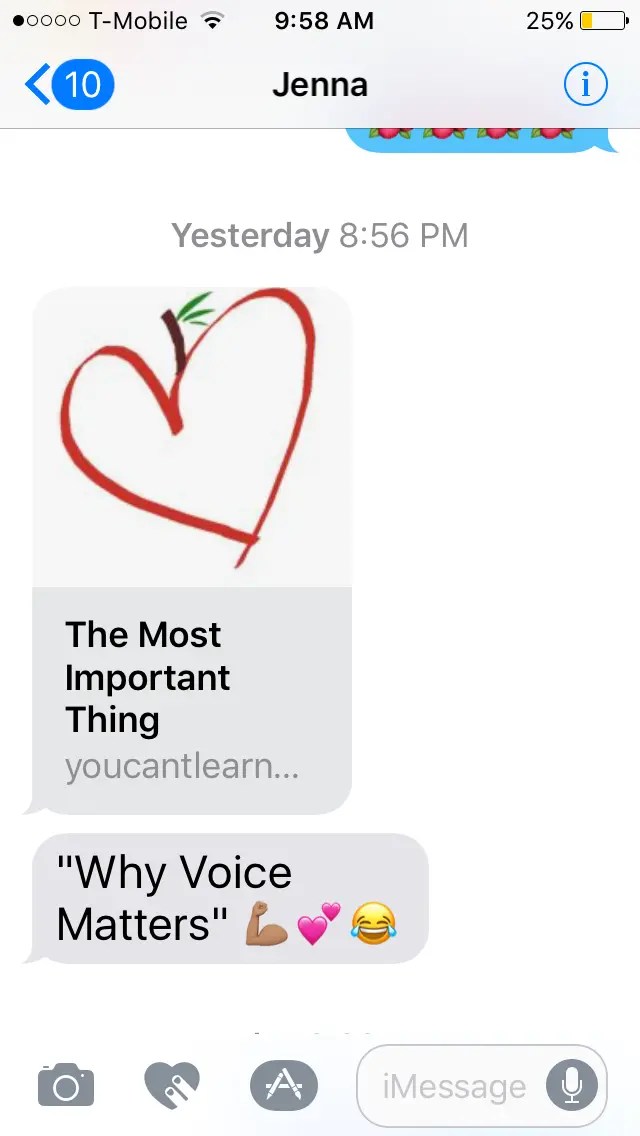
Later in the evening, I got a text from Jenna, who was just returning from the Intergroup Dialogue Conference at Cornell University in Ithaca, NY.

Text from Jenna: The most Important Thing

It was a link to another blog post, written by a 2013 graduate who was closely connected to HYPE through the Youth Media course we team teach.  Experience with HYPE and youth media, encountering Freire and Pedagogy of the Oppressed in particular, opened up for Julie new possibilities for imagining her future.  For the first time, in her senior year of college, Julie (a scholar athlete and award-winning member of the college’s women’s basketball team) began to seriously consider becoming a teacher and towards the end of that semester she was interviewing with Teach for America.

Julie was one of the students I had in mind when I wrote the passage above.  I was thinking about the community of learners we try to create around HYPE and youth media.

It’s been four years since Julie graduated.  And on her WordPress blog, where she continues to offer a narrative of her experience as a novice teacher, she quotes Couldry’s Why Voice Matters.

julie

Julie’s post reminds me that this work for students–hopefully–continues long after they leave campus.  That’s one of the ideals, I would say, of a liberal arts education, the habit of making connections across their studies and lived experiences.  Julie’s blog (https://youcantlearnwithoutlove.wordpress.com/) offers a narrative of her experiences as a young white teacher, first in Providence, Rhode Island and now in Philadelphia.  “I was a wide-eyed twenty-two year old…”

These glimpses of what she is doing beyond graduation, the identity she is constructing as a teacher, matter deeply.  That she continues to try to enact and embody some of the theory and principles that she encountered through HYPE four years ago is why HYPE matters on our campus.  That she sees her work as a teacher to include, centrally, practicing the value of voice, is perhaps the most powerful reminder of why voice matters.

Featured Image by Jerry Kiesewetter on Unsplash

]]>
56620
New DTLT Podcast – Closing Tabs! https://umwdtlt.com/new-dtlt-podcast-closing-tabs/ Thu, 12 Oct 2017 14:32:26 +0000 http://umwdtlt.com/?p=56565 http://umwdtlt.com/wp-content/uploads/2017/10/Donglecast-1-1.mp3

Podcast: Play in new window | Download

We’ve long supported creating podcasts and other audio projects here at DTLT and through the DKC. However, it’s been a while since anyone at DTLT has actually made a podcast.

Podcasting has experienced a kind of renaissance. The first podcast boom started in around 2004 with the release of the first iPod, but with podcasts like Serial becoming a runaway pop culture phenomenon and increased platforms and ease of podcast production, there is now a podcast for everything.

Including, now, DTLT.

Kris Shaffer and I are co-hosts of Closing Tabs. We will be having open discussions with our colleagues here in DTLT, DKC, and elsewhere in the UMW community, as well as guests who happen to drop by. We’re looking forward to sharing the work done here at UMW around the Digital Liberal Arts and Domain of One’s Own with a wider audience, while also keeping the community up-to-date on what’s going on at DTLT.

Our first episode is an introduction to the Domain of One’s Own curriculum, and we will be breaking down and talking about the individual modules as the first handful of episodes. Suggested topics are welcome, just email dtlt@umw.edu if you have an idea or would like to be a guest!

Subscribe to Closing Tabst by adding this feed to your podcasting app of choice: http://umwdtlt.com/category/closing-tabs/feed/.

Featured Image by TheAngryTeddy on Pixabay 

]]>
56565