???? On the 12th day of …
12 Data Points
University of Mary Washington’s Domain of One’s Own (DoOO) project currently hosts 2,422 active domains. The project launched over 4 years ago with 116 pilot domains. In Fall of 2013, Domain of One’s Own expanded as a way to give free domains and hosting to every student and, in fact, every member of the UMW community. Over the course of 3 years, there were 70 participants in Faculty Initiative, a Domain of One’s Own faculty development project. The Digital Knowledge Center, a peer tutoring center, opened in Fall 2014. Since then, the Center has offered 345 Domain of One’s Own tutorials. The most popular months for new sign-ups are January and September, marking the start of our semesters, but sign-ups continue consistently throughout the year (with as many as 850 new domains in a single year). This fall, we’ve already had 300 new users create domains. The Domain of One’s Own project continues to spread. Currently, over 40 other schools have active initiatives inspired by Domain of One’s Own and over 100 schools have individual faculty implementing DoOO at the course level.

11 Student Domains
Meredith Fierro, dgst395.meredithfierro.com
Madison Buechler, madisonbuechler.com/blog
Dominique Giles, tiredmimi.com,
Elaina Finkelstein, elainafinklestein.com
Amy Fanghella, delovelyames.com,
Natalie Griffitts, nataliegriffitts.com
Margaret Neubig, educationforpreservation.margaretneubig.com
Nancy Milroy, humansofumw.com
Amy Wallace, hist329.amywallaceumw.com
Amanda Halprin, www.amandahalprin.com

10 Articles
Audrey Watters, “The Web We Need to Give Students”
Andrew Rikard, “Do I Own My Domain if You Grade It?”
David Morgen and Pete Rorabaugh, “Building Community and Critical Literacies with the Domain of One’s Own Incubator”
Kate Bowles, “For Now, Our Own”
WIRED, “Domain of One’s Own”
Jim Groom, “A Domain of One’s Own”
Richard V. Hurley, “A Place of One’s Own — Online”
Martha Burtis, “Making and Breaking Domain of One’s Own: Rethinking the Web in Higher Ed”
Alan Levine, “Domains: Own, Value, Care, Time”
Debra Schleef, “Who’s Afraid of Domain of One’s Own?”

9 Significant Moments
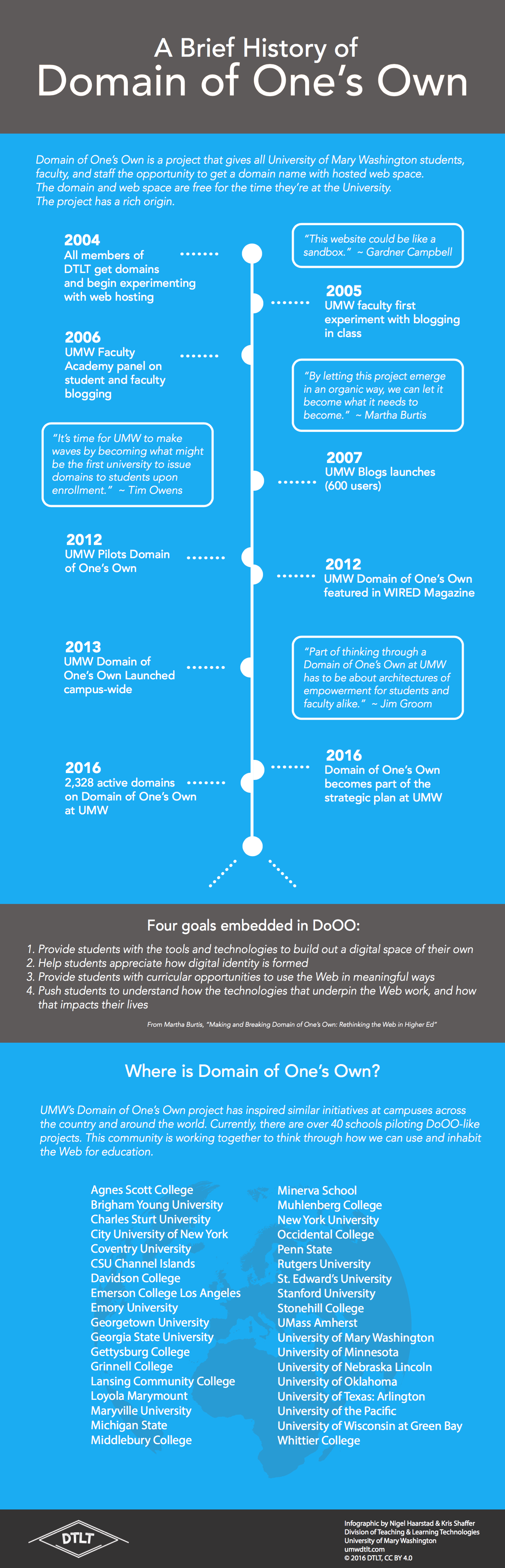
2004 — All members of DTLT get domains and begin experimenting with web hosting
2005 — UMW faculty first experiment with blogging
2006 — UMW Faculty Academy panel on student and faculty blogging
2007 — UMW Blogs launches
2012 — UMW pilots Domain of One’s Own
2012 — UMW Domain of One’s Own featured in WIRED Magazine
2013 — UMW Domain of One’s Own launches campus-wide
2016 — Domain of One’s Own becomes part of the strategic plan at UMW
2016 — 2,422 active domains on Domain of One’s Own at UMW
Source: umwdtlt.com/an-infographic-of-ones-own

8 Faculty/Staff Domains
Zach Whalen (English, Linguistics, and Communication): amillionbluepages.net
Jack Bales (Library): wrigleyivy.com
Susan Fernsebner (History and American Studies): taipingcivilwar.org
Parrish Waters (Biological Sciences): umwvisionandchange.com
Melina Patterson (Geography): cities.melinapatterson.net
Kris Shaffer (DTLT): ds106.pushpullfork.com
Jeff McClurken (History): mcclurken.org
Andréa Livi Smith (Historic Preservation): survey.andrealivismith.com

7 Building Blocks
- Digital Identity
- What is a Domain?
- Understanding the Web
- Copyright, Fair Use, Creative Commons
- Digital Citizenship
- Data Ownership & Usage
- Representation (gender, race, culture, orientation)
Source: umw.domains/modules

6 DoOO Schools
These are just a small few of the schools with Domain initiatives:
University of Oklahoma, Michigan State University, Middlebury College, Davidson College, Whittier College, Muhlenberg College
Source: reclaimhosting.com

5 Brilliant Quotes
Jeff McClurken, “Digital History and Undergraduate Digital Literacy”: “Increasingly I have become convinced that a key, but often overlooked, aspect of digital literacy is a willingness to experiment with a variety of online tools, and then to think critically and strategically about a project and to identify those tools that would be most useful to that project.”
Martha Burtis, “Coding, Serendipity, and Domain of One’s Own”
“As digital spaces increasingly become the platforms upon which we live our lives, we must teach students to understand that those platforms are coded spaces, built by humans with business goals, political opinions, and complex identities.”
Audrey Watters, Claim Your Domain and Own Your Online Presence
“What do we want students to do or be in a digital world? If nothing nothing else, they should have agency, autonomy, and critical awareness of what it means to live, work, and play in a digital world.”
Doug Belshaw, “Digital Literacy, Identity and a Domain of One’s Own”
“A world where one’s primary identity is found through the social people-farms of existing social networks is a problematic one. Educators and parents are in the privileged position of being able to help create a better future.”
Maha Bali, “Sharing/Ownership ≠ Empowerment”
“We cannot assume agency. And we cannot assume lack of it. We cannot assume minorities will manage without support, nor can we assume they are incapable.”

4 Pedagogical Goals
- Provide students with the tools and technologies to build out a digital space of their own
- Help students appreciate how digital identity is formed
- Provide students with curricular opportunities to use the web in meaningful ways
- Push students to understand how the technologies that underpin the web work, and how that impacts their lives
Source: umwdtlt.com/an-infographic-of-ones-own

3 Founders
Martha Burtis
Jim Groom
Tim Owens

2 Reasons to Get a Domain
I, Jess, believe everyone should should be able carve out (and make decisions about) some small piece of the web. Having a domain is a way to own, or occupy, and to have an important kind of control over a space in the vast world that is the Internet.
I, Jesse, believe getting a domain is a very personal choice. It requires careful consideration of what it is to work on the web. Working in public is never without risk, but it means something very different when we are gay, women of color, undocumented, disabled, trans, students, teachers. The work is never as easy or as simple as buying a domain name or uploading an app to a shared server. I deeply respect the Domain of One’s Own project, because it has never made light of these things, and because it offers a space of possibility.

And 1 Domain to Rule them All
Yours…

Image by Markus Spiske CC-0.
]]>Our goal with this series of posts is to offer a version of that history. Our approach isn’t about establishing a chronology; rather, we want to explore the origins and genealogy of the project, to capture its spirit, and to look toward its future. Because DoOO focuses so intimately on identity and what it means to be fully human on the web, we are starting this series with our stories — how we came to know Domain of One’s Own, how it has shaped us, and how we will help shape it.
What is DoOO?
Domain of One’s Own is a project that gives all University of Mary Washington students, faculty, and staff the opportunity to get a domain name with hosted web space. The domain and web space are free for the time they’re at the University. The project has a rich origin. Since 2004 every member in the Division of Teaching and Learning Technologies has had a domain name and Web hosting. That was also when DTLT, began experimenting with open source platforms, which made the Web more accessible. One of the founders of DoOO, Martha Burtis, explains how open sources tools “made it possible to build learning environments that empowered students, and not necessarily to the detriment of the course.” In 2007, DTLT began to wonder, “what if every faculty member and student had their own domain name and their own space on the Web?”
Eventually, the “what if’s,” became “needs.” Members of the UMW Community needed “a space online that they not only control and own but they understand how it works.” Thus, Domain of One’s Own was born. Through the hard work of Martha Burtis, Jim Groom, and Tim Owens, along with the rest of DTLT, Domain of One’s Own piloted in 2012 with a small cohort of faculty and students. Part of the success of that first year was the faculty development initiative sponsored by DTLT and Mary Kayler in UMW’s Center for Teaching Excellence and Innovation. Almost immediately, the project garnered national and international attention. Starting in 2013, domains became available for any member of the UMW community, including staff, faculty, and students. There are currently over 2000 active UMW Domains.
Domain of One’s Own is in part a response and an antidote to the emerging discussion around ePortfolios, while also resisting traditional educational platforms that look nothing like the rest of the Web. According to Audrey Watters, the project helps faculty, staff, and students at UMW “have more control over their scholarship, data, and digital identity.”
Discovering Domain of One’s Own
I (Jess) first encountered Domain of One’s Own on August 29th, 2012. Over the summer of 2012, I took a web authoring and design class at George Mason University. GMU provided us a tilde space where we could host our hand-coded websites using our newfound HTML and CSS skills. Upon returning to UMW, I looked to see if UMW had tilde spaces for students, because I wanted to continue to practice. After much googling, I found a blog post that Jim Groom had written the day before called Documenting Domain of One’s Own. I didn’t know him, I didn’t know about UMW’s Division of Teaching and Learning Technologies (DTLT), I just knew I wanted web space, preferably free. After reading the post, which explained more about the pilot, I boldly commented, “Hi, I’m a student here at UMW and this sounds like a great idea! Can students sign up for it now? If not, because it’s still a work in progress, how can I access my webspace via Secure File Transfer application? I was doing so at GMU over the summer and I was hoping I could here too, just to start working a site that I’d use primarily to showcase my future history research projects.” With the encouragement of my professor, Susan Fernsebner, I created a website for the final presentation in my History Seminar. From there, I continued to redesign the sites I built by hand until I was introduced to WordPress by a (former) DTLT member, Ryan Brazell.
I worked with course blogs and WordPress throughout the rest of my time as an undergraduate at UMW. In 2014, my relationship with Domain of One’s Own changed significantly. While taking Jeff McClurken’s Adventures in Digital History course, I got to spend time in DTLT learning how to make child themes in WordPress. When DTLT moved to the Hurley Convergence Center, I applied to be a tutor at the Digital Knowledge Center (DKC), a peer tutoring center where students get help with digital projects. The possibility of working with digital tools and platforms interested me, and so I also added a Digital Studies minor just before my senior year. I went from dabbling with my domain to thinking critically about how Domain of One’s Own could help me build and shape my digital identity. This is when I realized how a project like DoOO could help students and faculty rethink how the web works and what we can do there.
In my role as a tutor at the DKC, I was supervised and mentored by Martha Burtis. I learned a lot and got experience with a bunch of digital tools. I learned what the backend of Domain of One’s Own looks like and how to fix common problems on the system. For me it was all very exciting — to see under the hood of a large scale project like DoOO. I was also able to witness DTLT at work, consulting with faculty just on the other side of the glass from where I was working in the DKC. They were empowering faculty and I was empowering students. However, I knew my time with the DKC and interacting with DTLT was going end. That thing called graduation happened, and I threw my resume out to a bunch of jobs that had digital components, but none were as interesting as the work I had done at UMW. DTLT announced an Entry-Level position, and it felt like the job had been created just for me. I applied, interviewed, and got the job. Now with my new colleagues, I support WordPress and Domain of One’s Own, and present to classes about digital identity. I’m looking forward to the future of Domain of One’s and what my second year in DTLT has in store!
Inhabiting the Course, Inhabiting the Web
I (Jesse) knew I wanted to be a teacher when I was a 9-year-old kid. My mom was in graduate school, and I’d stay up with her late into the night while she studied. Sometimes, I’d do her Anatomy Coloring Book homework for her, but I’d also spend hours piling up her textbooks to design syllabi. (I didn’t actually know the word “syllabi” at the time.) In 1999, I helped design my first official syllabus as a teaching assistant. In 2001, shortly after I started teaching courses of my own, I decided to eliminate paper syllabi. Taking my classes paperless was as much environmentally motivated as it was driven by a gut instinct that the syllabus for a course shouldn’t be static — that the syllabus should be dynamic and that students should have a hand in creating the framework for a course. If my 9-year-old self could design syllabi, why do teachers patronize to adult students by dictating to them the shape of their learning? Not all teacher-created syllabi are bad, and I believe the teacher has an important role in helping to shape the learning that happens in a class. But syllabi, as long as I’ve known them, are too often defensive documents aimed at controlling students through absurd levels of bureaucracy.
So, in 2002, I started hosting my own syllabi on the web, but they were more than just syllabi. Over the years, they morphed increasingly into course sites authored as much by students as by me. I would open the space, but I was only one of many that would inhabit it. And I’d often use the course site from one semester as a starting point for the next, so students would also build upon each other’s thinking from semester to semester across years. As much as possible, I tried to de-emphasize the administrivia of a conventional syllabus (the bits required by institutions) so that the subjects of the course and student work would be foregrounded. I also made my course sites conversation spaces, starting with e-mail lists, evolving through Google groups, blog comments, and Twitter feeds. My goal was always to destabilize the “front of the class” — to show up as a teacher myself but to create ample opportunities for students also to show up as teachers.
The Domain of One’s Own project at University of Mary Washington caught my attention very early on, as it germinated, well before it was fully rolled out on campus. At the schools where I’d taught, my work had always been done against the flow of the institution. But UMW was supporting the work at an institutional level and making the work explicitly about student agency. When I talked to Jeff McClurken about my current position as Executive Director of DTLT, he had me at hello. And this is why: In a recent conversation about DoOO, Jeff remarked, “It is sadly unusual to tell students the work they do in their classes is theirs. That it matters. That they should share it. That they own it. That their digital identity can be developed by them, not by their teachers, the institution, and not, Dear God, by the LMS.” Learning is not static. Students are not receptacles. Technology should not be about surveillance. The web is a place we can inhabit. These things are at the heart of Domain of One’s Own, which as of 2016 has been enshrined in UMW’s Strategic Plan.
Looking Forward
We (Jess and Jesse) now work together (with the rest of DTLT) to help shepherd Domain of One’s Own. But we recognize that the work is the result of so many that came before us. There was an idea, and that idea had parents, but so much of the work of DoOO has been done in the classroom by faculty at UMW and the thousands of students they’ve collaborated with. So much labor, and so much heart, have gone into this project. Jess’s experience has been vital to DTLT, because she’s worked on all sides of the platform. And we’ve also learned immensely from the expanding community of institutions around the world starting their own DoOO-inspired initiatives. The project continues to grow and change. As Martha Burtis writes, “By letting this project emerge in an organic way, we can let it become what it needs to become.”
Over the next few years, what we’d like to see, is for the DoOO community to increasingly become a student community — not just technologists talking to each other from one institution to another. How can we open our pedagogies so that students at schools around the world are inhabiting the space of the web together — so that our classes are made permeable and allow students to engage on the public web across cultural and geographic boundaries?
And how do we make sure that these spaces are not obligatory — that they are spaces students choose to make, choose to inhabit, choose to learn within, and perhaps choose to continue learning within once they graduate? As UMW faculty member Debra Schleef writes, it should be “a choice to keep one’s domain, to change it significantly, or not to use it at all.” How do we assure that DoOO doesn’t become another space, like the LMS, designed to track, monitor, regulate, and control students?
To answer these questions, we find ourselves looking back even as we look forward, and so our hope with this series of posts is to investigate the history (anecdotal and otherwise) of DoOO, even as we continue to imagine its future.
[Photo “hedgehog” by flickr user plus45 licensed CC BY-NC-ND 2.0]
]]>